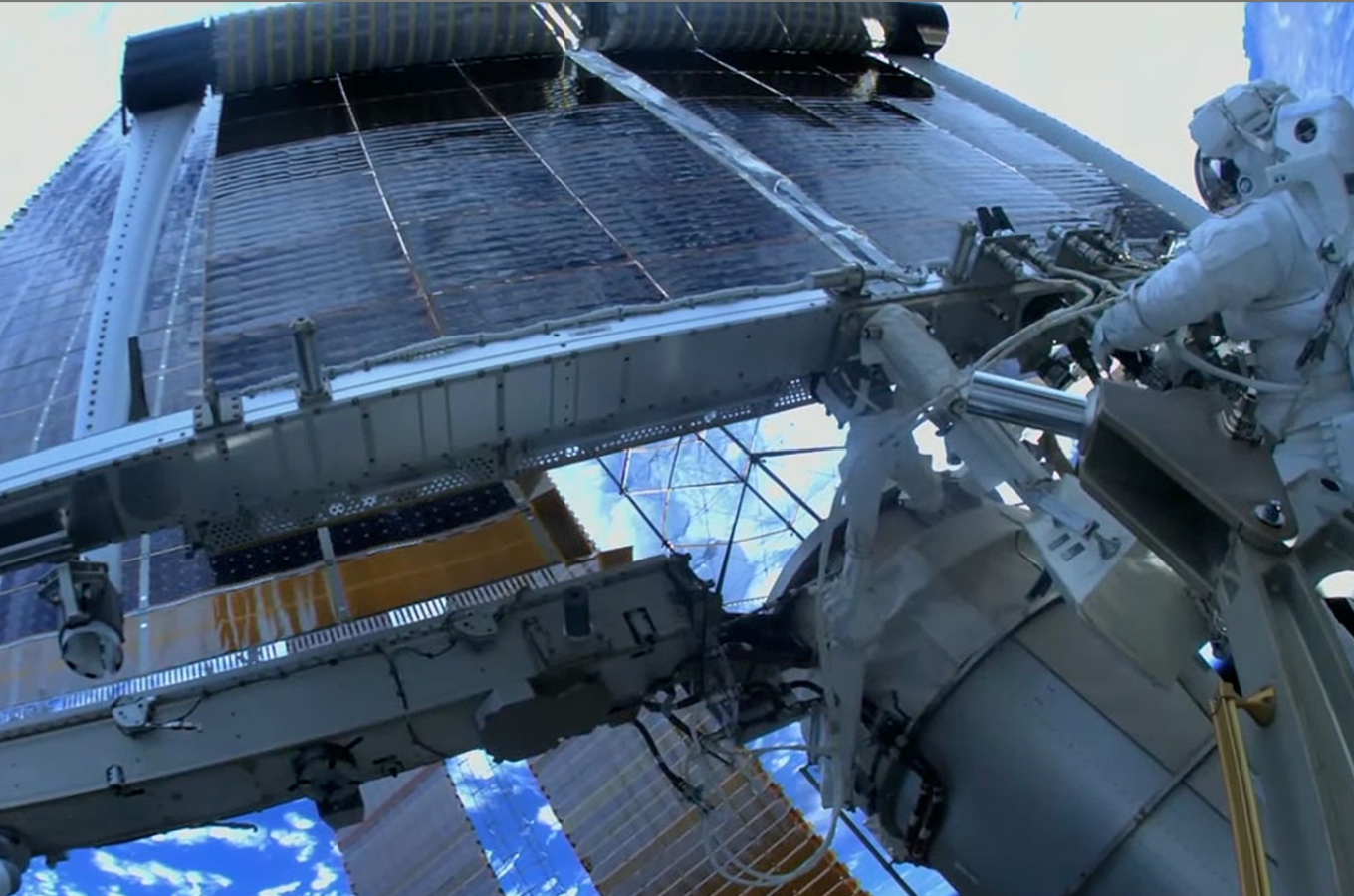
In a significant milestone for the International Space Station (ISS), Russian cosmonauts Oleg Artemyev and Denis Matveev successfully completed a spacewalk on September 2, 2022. The extravehicular activity (EVA) lasted 7 hours and 47 minutes and was crucial for the ongoing maintenance and expansion of the station.
Preparing the Nauka Laboratory and European Robotic Arm
During the spacewalk, Artemyev and Matveev focused on outfitting the newly arrived Nauka laboratory module and preparing it for full operational use. One of their primary tasks involved relocating an external control panel for the European Robotic Arm (ERA), which will allow astronauts to handle payloads more efficiently in the future.
Additionally, the cosmonauts tested a rigidizing mechanism, designed to strengthen structural components for future experiments and cargo transfers. They also extended the Strela cargo crane from the Zarya module to the Poisk module, enhancing the station’s ability to move equipment and supplies during EVAs.
A Record-Breaking Year
This was the eighth Russian spacewalk in 2022 and marked the 253rd spacewalk in the history of the ISS for assembly and maintenance purposes. The successful EVA underscores the meticulous planning and coordination required to maintain a multi-national orbiting laboratory.
Significance of the Mission
The work performed by Artemyev and Matveev is vital to the ISS’s continued support for scientific research and international collaboration. By preparing the Nauka module and ensuring the European Robotic Arm is fully operational, the spacewalk enhances the station’s capability to conduct experiments, transport cargo, and support astronauts during future missions.
NASA and Roscosmos have emphasized that spacewalks like this one are critical for the long-term sustainability of the ISS. Each successful EVA contributes to the station’s infrastructure, safety, and its ability to serve as a hub for scientific innovation in low Earth orbit.
As space agencies continue to prepare for more complex operations and potential future missions to the Moon and Mars, these maintenance spacewalks play a foundational role in ensuring that the ISS remains a functional and safe platform for exploration.
About The Author