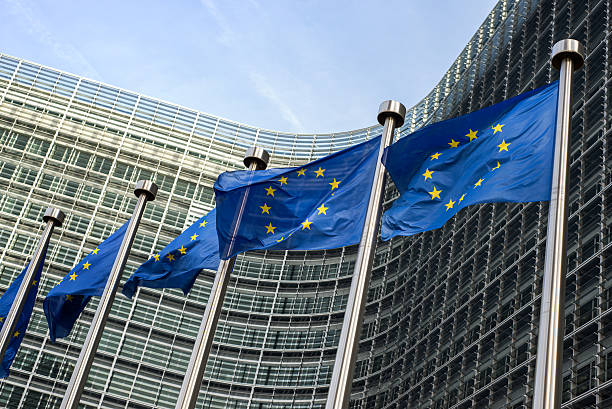
European Union flags in front of the Berlaymont building (European commission) in Brussels, Belgium.
For decades, Europe has relied heavily on the United States for military support, particularly through NATO, to counter threats from adversaries like Russia. But with growing political divides and shifting priorities in Washington, Europe now faces its greatest challenge: confronting Russian aggression without the same level of US support that has been crucial in previous conflicts. This seismic shift is forcing European nations to rethink their security strategies and re-evaluate their position in the world, as they confront the reality of fighting Putin’s Russia without the US as their primary ally.
A Changing Dynamic in Transatlantic Relations
The US has historically been the cornerstone of European security, providing military power, resources, and strategic leadership within NATO. However, under former President Donald Trump, there were repeated calls for European nations to shoulder more of the financial and military burden, with NATO members frequently urged to increase defence spending. While the Biden administration has returned to a more traditional approach of supporting NATO and European security, it has become increasingly clear that Europe cannot rely solely on the US to confront Russian aggression, especially with the growing political isolationism seen within the US itself.
The political divide within the US has become more pronounced, and as the 2024 elections approach, the future of America’s involvement in global conflicts, including in Europe, is uncertain. The rise of populist and isolationist movements in the US raises questions about how long the US will continue to take an active role in European security. This leaves European nations in a precarious position, realising that they must prepare to defend themselves against Russian threats without the military might of the US leading the charge.
Russia’s Growing Influence
Russia’s President Vladimir Putin has shown little sign of backing down in his quest for territorial expansion and geopolitical influence, particularly in Ukraine. His aggressive actions in Ukraine and his increasingly belligerent stance toward the West have forced Europe to take a harder look at its own defence capabilities. But Europe’s ability to effectively counter Putin’s Russia is severely limited by both military and political challenges.
While European countries, especially those in Eastern Europe, have long been wary of Russia’s intentions, there remains a stark imbalance in military capability between Russia and Europe. The European Union’s combined military might, while substantial, is not as cohesive or integrated as the US-led NATO forces. There is no unified European army, and individual European nations’ military forces are often scattered and underfunded, making a coordinated and effective military response to Russia’s advances difficult.
Furthermore, Europe’s dependence on Russian energy supplies, particularly natural gas, has made some countries more hesitant to confront Putin head-on. The ongoing energy crisis in Europe, exacerbated by the war in Ukraine, has forced European leaders to walk a delicate line between confronting Russia and managing their own domestic energy needs. The current geopolitical crisis has only intensified the urgency for Europe to reduce its dependence on Russian energy while ensuring its military readiness.
The EU’s Efforts to Take the Lead
In light of these growing concerns, the European Union has been pushing for more strategic autonomy in its defence and foreign policy. The idea of a “European Defence Union” has gained traction in recent years, with European leaders recognising the need to reduce their reliance on NATO and the US for security. The EU has already taken steps towards this by increasing its military cooperation through initiatives like PESCO (Permanent Structured Cooperation) and launching its own European Defence Fund to support military research and development.
However, these efforts have yet to reach the level necessary to confront a threat as formidable as Russia. While European countries such as France, Germany, and the UK have strong military forces, the overall European defence framework lacks the coordination and cohesion that a unified defence strategy would require. The absence of a centralised European military command structure and the diversity of national interests make it difficult for Europe to present a unified front against Russia. This fragmentation is a major vulnerability, especially when Russia’s military power continues to grow and evolve.
The Economic Challenge
In addition to military challenges, Europe is also facing economic pressures in its efforts to combat Russia. The sanctions placed on Russia in response to its invasion of Ukraine have had a significant impact on Europe’s economy, leading to rising energy costs and inflation. The EU’s resolve to maintain these sanctions and continue supporting Ukraine financially has been tested, particularly in countries like Hungary, which has been more reluctant to impose further sanctions or take aggressive stances against Russia.
Europe’s economic strength is vital in the fight against Putin, as it provides the resources necessary to sustain military efforts, support Ukraine, and deter further Russian aggression. However, Europe’s economic cohesion is being strained by internal divisions, and the inability to fully decouple from Russian energy supplies has complicated Europe’s position. The challenge for Europe now is to maintain a united economic front while managing the internal pressures that come from energy shortages and inflation.
A New European Leadership?
With the US potentially less engaged in European security, the responsibility for defending Europe from Russian aggression increasingly falls on the shoulders of European leaders. Countries like France, Germany, and the UK will need to take the lead, not only in military and economic efforts but also in fostering unity within the EU. The geopolitical shift requires a new approach to leadership, one that recognises Europe’s collective power while also addressing its divisions.
This new leadership must prioritise long-term military preparedness, strategic autonomy, and the development of stronger economic and diplomatic ties within Europe. There will need to be greater cooperation on defence spending, energy independence, and the development of joint military capabilities to ensure that Europe is not left vulnerable to external threats.
The reality of confronting Putin’s Russia without the full support of the US marks a new chapter in Europe’s geopolitical history. As the US turns inward and Europe faces the threat of an increasingly aggressive Russia, the continent’s ability to defend itself will be put to the test. With military, economic, and diplomatic challenges on the horizon, Europe must come together to develop a unified and sustainable response to Russian aggression. The outcome of this struggle will determine the future stability of Europe and its position on the global stage. Europe’s nightmare is indeed here, and how it responds will shape the course of history.
About The Author